"What's your rate?" It's the question every creator dreads. Quote too high and the brand disappears. Quote too low and you've worked for less than your data costs.
There's no official price list for influencers in Nigeria, and rates vary a lot by niche, platform and city. But there is a sensible way to work out your price. Here's the method we see working for creators on Aktivate.
Step 1: Price your views, not your followers
Follower count is the number brands look at first, but views are what they're actually paying for. A creator with 8,000 followers who gets 15,000 views per Reel is worth more than one with 40,000 followers who gets 3,000.
Work out your average views per post on each platform over your last 10 posts. Leave out your one viral hit so the average is honest.
Step 2: Pick a base rate per 1,000 views
Decide what you'll charge for every 1,000 views you typically get. This is called a CPM (cost per mille).
The formula:
Base price = (average views ÷ 1,000) × your rate per 1,000 views
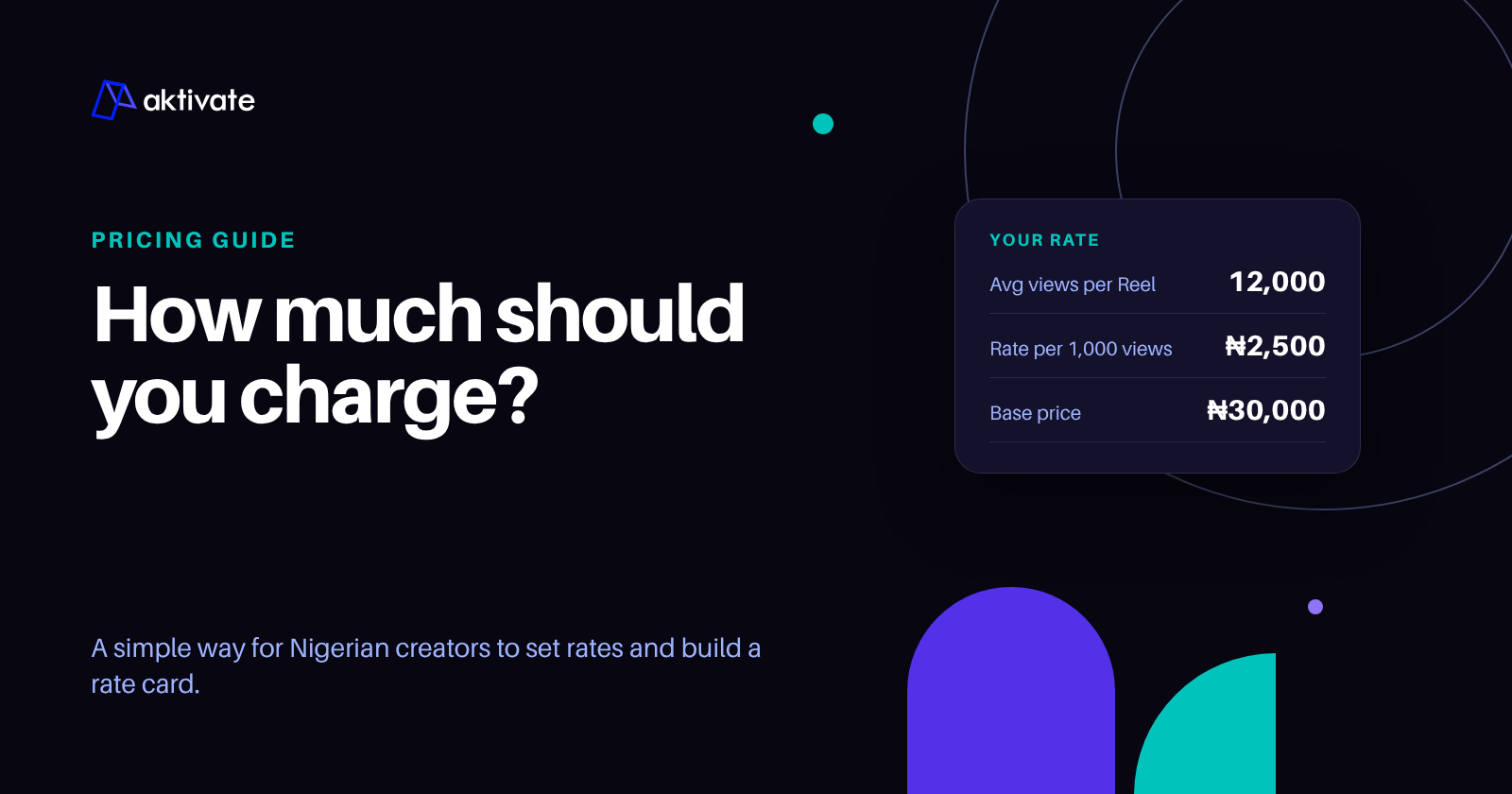
Example: you average 12,000 views per Reel and set your rate at ₦2,500 per 1,000 views. Your base price is 12 × ₦2,500 = ₦30,000 per Reel.
The rate per 1,000 views is yours to set. Start at a level you're comfortable defending, then raise it as brands keep saying yes. If every brand accepts instantly, you're too cheap.
Step 3: Adjust for what makes your content worth more
| Factor | Effect on price |
|---|---|
| High engagement (lots of comments, saves, shares) | Up |
| Niche audience brands struggle to reach (finance, tech, parents, B2B) | Up |
| Audience mostly in Lagos, Abuja or Port Harcourt (for brands selling there) | Up |
| Polished production: scripting, editing, voiceover | Up |
| Fast turnaround needed | Up |
| Long-term deal (several posts over months) | Down per post, more in total |
| Product you'd have bought anyway | Optional discount |
Step 4: Charge for usage rights and exclusivity
These are the two things Nigerian creators most often give away for free.
- Usage rights: if a brand wants to run your video as an ad, put it on its own page or use it on billboards, that's extra. A common approach is to add a percentage of your base price for each month of usage.
- Exclusivity: if a brand asks you not to work with competitors for a period, you're giving up income. Charge for it.
Step 5: Build a simple rate card
A rate card makes you look professional and saves time. Keep it to one page:
- Your name, handle, niche and audience location
- Average views and engagement rate per platform
- Prices for your main formats: Reel or TikTok, story set (3 frames), static post, YouTube integration
- Package prices (for example, 1 Reel + 3 stories)
- Add-ons: usage rights per month, exclusivity, extra revisions
- Payment terms: for example, 50% upfront, 50% on posting
What about small creators?
If you have under 10,000 followers, you're a nano creator, and brands in Nigeria actively look for you because nano audiences trust their creators. You can still charge. Start with paid campaigns that fit your niche, and add commission-based income so every post earns more than its fee.
With ShopLink, you can add a brand's products to your own store and earn 5–50% commission on every sale, on top of any campaign fee. That way your income isn't capped by your rate.
Mistakes that cost creators money
- Quoting before you know the brief. Ask for deliverables, timeline and usage first.
- No written agreement. Even a short email confirming deliverables, price and payment date protects you.
- Working for "exposure". Exposure doesn't pay for data. Products-only deals are fine occasionally, but they're not a business.
- Never raising your rates. Review your prices every three months as your views grow.
Find paid campaigns
On Aktivate's Collaboration Hub, brands post campaigns with the budget and deliverables upfront, so you know what's on offer before you apply. And if brands keep skipping you, check whether your profile is the problem.